Surviving the "Waiting Room": Why Professionals Self-Destruct During a Disciplinary Investigation.
For a high-performing CEO, Senior Partner, or Director, the start of a professional disciplinary investigation or conduct review is more than a legal hurdle. It is an Identity Shock. In an instant, the "command and control" mindset that built your career becomes your greatest liability. You are used to fixing problems by taking decisive action. But in the first seven days of a professional crisis, those instincts often lead to "self-destruction."
The Fatal Mistake: Information Bleed
The most common reaction to a professional standards review or a high-profile inquiry is the urge to "explain." You want to tell your side. You want to reassure your colleagues, your family, and your peers.
In my work as a Resilience & Reinvention Strategist, I call this Information Bleed. Every "off-the-record" coffee or "innocent" text message to a colleague is a leak in your legal and narrative perimeter. Strategic silence is not an admission of guilt; it is the first step of reputation protection.
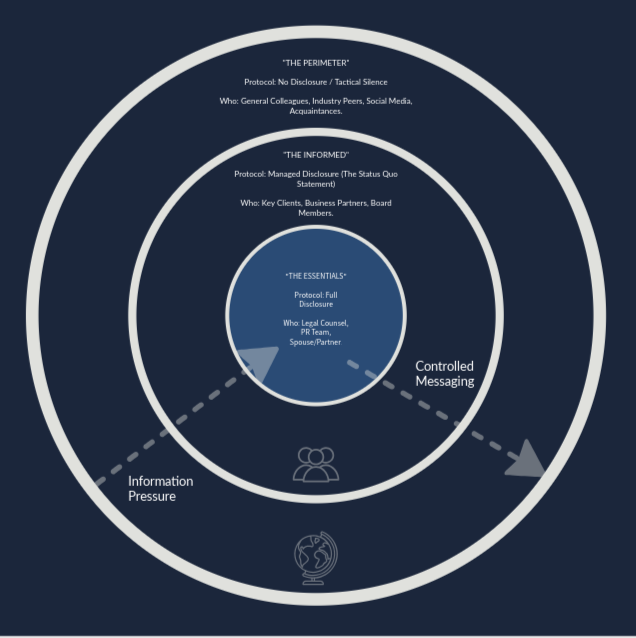
Mapping the Narrative Perimeter in a Professional Crisis
To survive the initial hit, you must stop viewing your contacts as "friends" and start viewing them as Stakeholders. You need a framework to determine who has a "Need to Know" and who represents a risk to your case.
As shown in the matrix below, your focus must be on collapsing the perimeter.
The Essentials (Tier 1): Your legal counsel and PR team.
The Informed (Tier 2): Stakeholders who require a "Status Quo Statement" to prevent panic.
The Perimeter (Tier 3): General industry peers who require Tactical Silence.
Navigating the "Waiting Room"
The first week marks the entrance into what I call the "Waiting Room"—that agonising period between the initial allegation and the final resolution. This is where most professionals lose their footing.
The psychological toll of a professional conduct investigation is immense. Most individuals spend this time "doom-refreshing" their inbox or playing out worst-case scenarios. This cognitive load makes you a volatile client for your legal team. If you are not mentally stabilised, you cannot make the disciplined decisions required to navigate a regulatory inquiry.
From Disciplinary Crisis to Professional Reinvention
You cannot control the pace of a disciplinary procedure, but you can control your internal response. My work is designed to complement your legal and PR strategy by providing "internal containment."
I help high-profile individuals move out of "Identity Shock" and into a structured Resilience Protocol. This includes:
Digital Boundaries: Implementing a "Digital Lockdown" to protect your mental health.
Family Stabilisation: Ensuring your inner circle is protected from the fallout.
Chapter Two Planning: Beginning the process of Professional Reinvention so you are prepared for whatever comes next.
The "Waiting Room" is a dangerous place to be alone. Stabilisation is the only way through.
Facing a professional review?
Don't try to "fix" a disciplinary investigation with the same habits that built your career. I offer a brief, 15-minute introductory call to see if my Resilience and Reinvention frameworks can provide the stability you need.
Once you have stabilised your digital perimeter, the next challenge is managing the silence that follows.
Read about Surviving the Information Void.